
Regulation ·
RBI data residency and calling an external LLM
The question is never whether an LLM API is allowed. It is which rule attaches to the specific field you are about to put in the prompt, and what the vendor contract says about audit.
An Indian regulated entity can call a hosted language model. What it cannot do is send payment system data abroad and leave it there, or outsource IT services to a provider that will not give the entity and the Reserve Bank inspection rights. The useful question is never whether an LLM API is allowed in the abstract — it is which rule attaches to the specific field you are about to place in the prompt, and whether your vendor contract survives the answer. We build these systems; we are not your compliance function, and the sections below are an engineering reading of published RBI material rather than legal advice.
Two rules, and they cover different data
Most confusion in this area comes from collapsing two separate instruments into one idea called data localisation. The 2018 payment data circular covers payment system data. The 2023 IT outsourcing direction covers the arrangement with your service provider. A given prompt may hit one, both or neither.
The first is the Reserve Bank's circular on Storage of Payment System Data, RBI/2017-18/153, dated 6 April 2018. Its operative sentence is short: all system providers shall ensure that the entire data relating to payment systems operated by them are stored in a system only in India, including the full end-to-end transaction details, information collected, carried or processed as part of the message or payment instruction. Only the foreign leg of a transaction, where one exists, may also be stored abroad.
The second is the Master Direction on Outsourcing of Information Technology Services, issued 10 April 2023 and effective 1 October 2023, applying to commercial banks, NBFCs, primary co-operative banks, credit information companies and all-India financial institutions. It governs the relationship rather than the field: what the contract must contain, who may audit, whether sub-contracting is permitted, and what happens when the arrangement ends.
An NBFC building an internal policy assistant over its own HR manuals is inside the outsourcing direction and outside the payment circular. A payments company building an assistant that reads settlement records is inside both. Classify before you architect.
The 24-hour rule is the one people misquote
Processing payment data outside India is not prohibited. The Reserve Bank's own FAQ says there is no bar on processing payment transactions outside India if the payment system operator wants to. The condition is what happens afterwards.
The FAQ states that where processing is done abroad, the data should be deleted from the systems abroad and brought back to India not later than one business day or 24 hours from payment processing, whichever is earlier. That is a deletion obligation with a clock, and it is the clause that decides whether a hosted model is usable for this class of data.
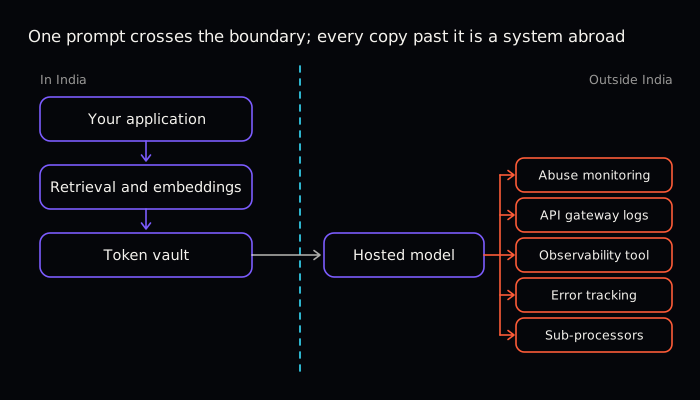
Run it against a real LLM integration. Your prompt goes to a provider outside India. Even with inference-time retention disabled, several things may persist: an abuse-monitoring copy held under the provider's standard terms, request logs at the API gateway, a copy inside whatever observability tool you wired in, and a copy in the provider's own error-tracking if a request failed. Each is a system abroad holding payment system data, and each has to be provably empty within the window. Contractual zero retention is achievable with some providers and some plans. It has to be in writing, it has to name every sub-processor, and someone has to test it rather than assume it.
The FAQ is also broad about what counts. Payment system data there includes customer data such as name, mobile number, email, Aadhaar number and PAN; payment sensitive data such as customer and beneficiary account details; payment credentials such as OTPs, PINs and passwords; and transaction data including originating and destination system information, references, timestamps and amounts. That list is worth reading twice, because a name and a mobile number are in it, and those two fields appear in almost every prompt anyone writes in a support context.
- Enumerate provider-side retention: inference logs, abuse monitoring, gateway logs, error tracking, sub-processors
- Get zero retention in the contract, not in a settings page, and re-check it when the plan changes
- Instrument your own side: an observability vendor hosted abroad is a system abroad
- Treat name and mobile number as payment system data when they travel with a transaction
The blocker is usually audit rights, not geography
The outsourcing direction requires that agreements provide for audit, monitoring and inspection rights for the regulated entity and for the Reserve Bank over the service provider. Most hosted model providers do not offer that to a mid-sized Indian NBFC, and that is the clause that stops deals more often than residency does.
The Master Direction also requires prior consent for sub-contractors, non-disclosure obligations, defined termination and exit processes, and monitoring of country-level risk with contingency and exit strategies where the arrangement crosses a border. Each is a hard conversation with a frontier model API. Providers subcontract to hyperscalers as a matter of course, and exit strategy means moving off a provider without the service stopping — a real engineering commitment for a system whose prompts were tuned against one model family.
This is why the architecture we recommend for regulated clients is not clever. Put a gateway between your application and any model, so provider choice is configuration. Keep prompt templates, retrieval and the evaluation harness provider-agnostic. Then the exit clause is honest, and switching providers after a failed negotiation is a week rather than a rebuild.
In-region hosted deployments from the large cloud providers change the residency answer without changing the audit answer. If you go that route, verify two things specifically: that the model you actually want is available in the India region rather than only in a distant one, and whether cross-region inference routing is enabled by default. Some services will silently route overflow traffic to another region unless you turn that off, which exports the prompt without any change to your code.
Redaction at the boundary is a design problem, not a regex
The workable pattern for regulated systems is to tokenise identifiers before the prompt leaves your control and detokenise on the way back. It works, and it fails in a specific way that everyone discovers late: free text.
Structured fields are easy. Account number, customer ID, PAN, mobile number — replace each with a reversible token from a vault held in India, send the prompt, map the tokens back on return. The model reasons over the shape of the problem without ever seeing the identifiers, and your audit trail records both sides of the mapping.
Free text defeats this. A call transcript in which a customer says their card ends in a particular four digits, a chat message naming a branch and a date, an email signature with a name and designation — all carry re-identifying information no pattern matcher reliably catches, and Indian names, transliterations and mixed-script input make named-entity recognition harder than English benchmarks suggest. The honest position is that redaction reduces exposure rather than eliminating it, and the reduction should be measured on your own traffic. Sample a few hundred real messages, run the redactor, have a human count what leaked. Anyone who gives you a leakage figure before seeing your data is guessing.
Where the residual risk is unacceptable, keep the whole pipeline inside your own network: open-weight models served in your VPC in an Indian region, with embeddings generated locally so no document text crosses the boundary. That removes the residency question and replaces it with a capacity and operations one — GPU cost, model refresh cadence, and the fact that you now own the uptime. Hybrid designs are defensible: internal retrieval and embedding, hosted generation over tokenised context.
- Token vault in India, reversible mapping, both sides logged
- Measure redaction leakage on your own traffic before relying on it
- Self-hosted open-weight models remove the residency question and add an operations one
- Hybrid: internal embedding and retrieval, external generation over tokenised context
What the FREE-AI framework adds
In August 2025 the Reserve Bank released the report of its committee on a Framework for Responsible and Ethical Enablement of Artificial Intelligence. It is a report rather than a direction, but it tells you what supervisory expectations are converging on.
The committee was constituted in December 2024 and reported on 13 August 2025. Its recommendations run to board-approved AI policy, risk committees combining senior management with technical expertise, model risk governance, graded audit mechanisms covering data accuracy and output compliance, and consumer-facing obligations: disclosing that the customer is interacting with an AI system, and providing a route to a human.
The recommendation with the most architectural weight is that final decision-making should vest with humans rather than models. Alongside it sits the sutra the committee calls Understandable by Design — decisions explicable in terms a human can follow. In practice that is the same durable record of every run our regulated clients need for their own reasons: inputs, documents retrieved, tool calls made, output produced, and the version of everything involved. If you cannot reconstruct why a system said what it said six months ago, you cannot answer a supervisor, a customer or an ombudsman. Build it from the start; it is the same infrastructure an evaluation harness needs — see how to evaluate a RAG system.
A decision procedure we actually use
Classify the field, then pick the deployment. Nearly every argument about LLM residency dissolves once someone writes down which fields are in scope for which instrument.
First, classify at the schema level rather than the system level. Tag each field: payment system data, KYC material, other personal data, or non-personal. Tags belong in the data model, so a new feature inherits them rather than re-deriving them from a meeting.
Second, ask what the assistant genuinely needs. A large share of the prompts we see contain fields nobody uses. Removing them is free and reduces the scope of the whole discussion.
Third, choose a deployment per class rather than for the whole product. Non-personal and internal documentation can go to a hosted model under ordinary terms. Other personal data can go to a hosted model under tokenisation with contractual retention limits and the outsourcing clauses in place. Payment system data either stays inside your network, or goes out only under a demonstrable delete-and-return-within-24-hours arrangement that someone has tested.
Fourth, write down the residual risks and who accepted them. Note that section 16(2) of the DPDP Act expressly preserves stricter sectoral requirements, so complying with that Act does not relieve you of the Reserve Bank's rules; the general picture is in what the DPDP Act actually requires of an AI system. What we will not do is tell a client a design is compliant. We will tell them exactly where the data goes, what is retained, for how long and by whom, in a document their compliance team can act on. Any engineering partner who blurs that distinction is doing you harm.
- Tag fields in the schema: payment system data, KYC, other personal data, non-personal
- Strip fields the assistant does not need before anything else
- Choose a deployment per data class, not one for the whole product
- Record residual risk and who accepted it, in writing
Sources
Every regulatory or measured claim above is attributed here. Where we could not find a source we trust, the sentence says so instead of guessing.
- Storage of Payment System Data (RBI/2017-18/153, 6 April 2018) — Reserve Bank of India · the storage-only-in-India requirement and the foreign leg exception
- FAQs on Storage of Payment System Data — Reserve Bank of India · processing abroad permitted; delete and return within one business day or 24 hours
- RBI releases Master Direction to regulate outsourcing of IT services — Khaitan & Co · issued 10 April 2023, effective 1 October 2023; audit rights, sub-contracting, exit
- A framework for using AI in the Indian financial sector (FREE-AI committee report) — S&R Associates · report published 13 August 2025; human decision-making, traceability, disclosure
Questions people ask about this
Can a bank in India use a hosted LLM at all?
Yes, subject to the Master Direction on Outsourcing of IT Services being satisfied — contract terms, audit and inspection rights for the entity and the Reserve Bank, prior consent for sub-contractors, exit strategy — and subject to payment system data not being stored abroad beyond the permitted window. The practical obstacle is usually the audit clause rather than the residency rule.
Does the 24-hour rule mean we can send payment data abroad for processing?
The Reserve Bank's FAQ says there is no bar on processing payment transactions outside India, provided the data is deleted from the systems abroad and brought back to India not later than one business day or 24 hours from payment processing, whichever is earlier. Meeting that with a hosted model means proving every copy is gone, including abuse-monitoring buffers, gateway logs and any observability vendor you have wired in.
Does using an India region of a cloud provider solve this?
It solves data at rest, which is a real part of the problem. It does not solve audit rights, sub-contracting consent or exit strategy, and it does not help if the specific model is unavailable in that region or if cross-region inference routing is left on. Check the routing default explicitly; it is the failure we see most often.
Is self-hosting an open-weight model the safe option?
It removes the residency and third-party retention questions and replaces them with operational ones you now own: GPU capacity, model updates, latency under load and your own security posture. For some regulated workloads that trade is clearly worth making. For others it is not, and a tokenised hybrid is the better engineering answer.
Related
Where this connects
RAG & LLM Integration
Retrieval that cites its sources, measured with a real evaluation harness.
AI Consulting & Readiness Assessment
A paid diagnostic that tells you what is worth building and what is not.
Custom Software Development
Line-of-business systems built to your process, owned outright by you.
Read next: What the DPDP Act actually requires of an AI system · The gap between an AI demo and something that runs unattended
More notes on the blog index, and the practical questions about cost, IP and data residency are on the FAQ.
Tell us which fields are in scope and we will map the rest
Scoping calls are free. Bring your field-level data classification, or the fact that you do not have one yet, and we will work out what a compliant architecture would actually cost you.